International Hiring & Talent Pipeline Issues in US Healthcare Staffing (2026 Deep Dive)
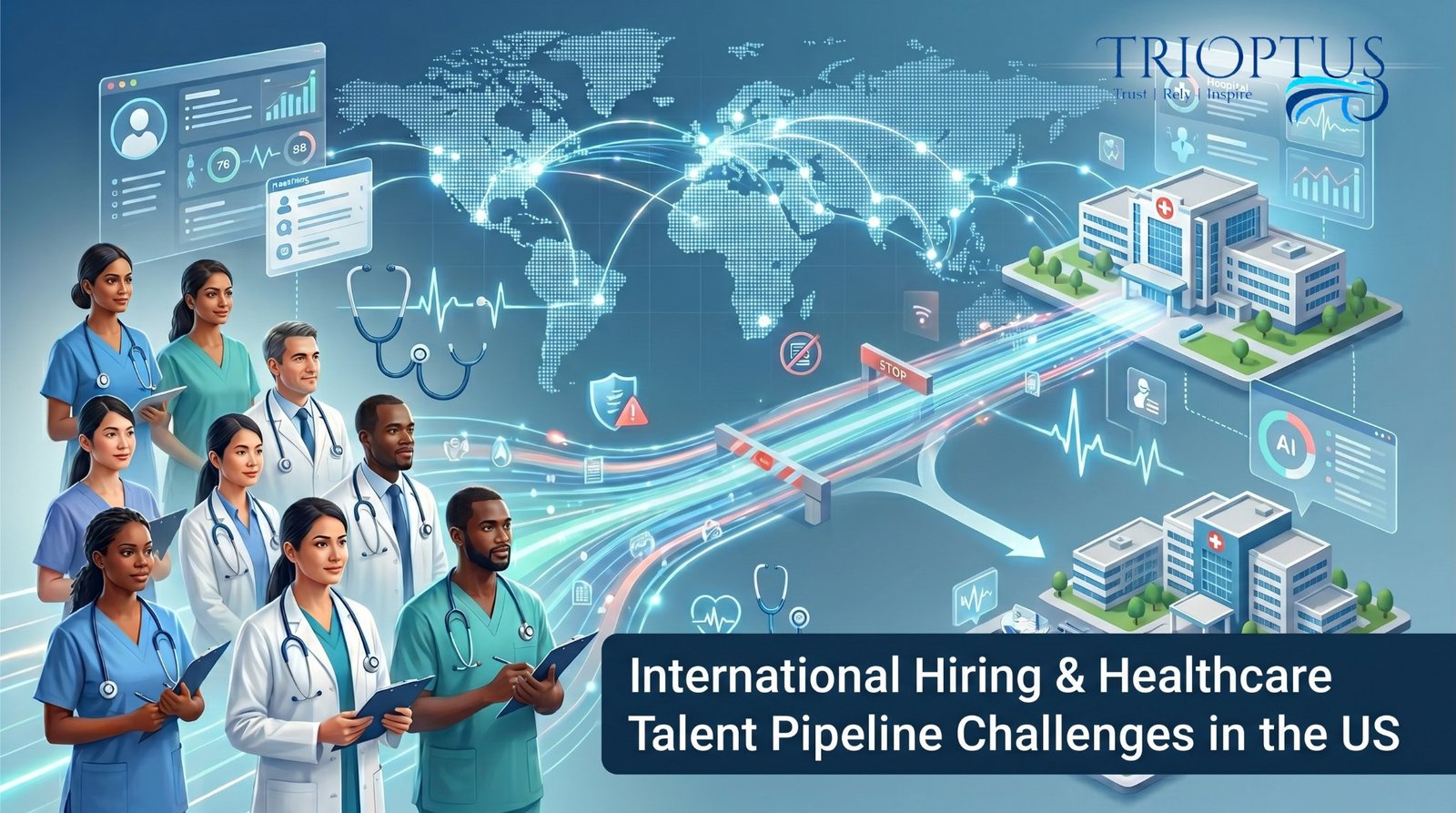
1. The US Healthcare Workforce Gap: Why International Hiring is Essential
The demand-supply imbalance in the US healthcare labor market is driven by multiple structural factors:
- Aging population increasing demand for care services
- Retirement of experienced healthcare professionals
- Burnout and attrition post-pandemic
- Insufficient domestic training capacity
This has created a scenario where:
Demand for healthcare professionals significantly exceeds domestic supply, especially in nursing and allied health roles.
Key Impact Areas:
- Rural and underserved regions face acute shortages
- Hospitals increasingly depend on contract and travel staff
- Staffing costs continue to rise due to competition
- International hiring has therefore become a strategic lever to stabilize workforce supply and maintain continuity of care.
2. Global Talent Pools: Where the US Sources Healthcare Workers
US healthcare staffing agencies typically recruit from countries with strong medical education systems and surplus workforce capacity.
Major Source Regions:
Philippines – Largest supplier of internationally educated nurses
India – Growing source for nurses, doctors, and IT-enabled healthcare roles
Nigeria & Kenya – Emerging markets for nursing talent
Caribbean nations – Regional proximity advantage
Eastern Europe – Specialized healthcare professionals
Why These Regions?
- English proficiency (critical for US healthcare environment)
- Comparable medical training standards
- Economic incentives to migrate
However, tapping into these talent pools requires navigating significant regulatory and logistical barriers.
3. Core Challenges in International Healthcare Hiring
3.1 Immigration and Visa Constraints
Visa sponsorship remains the single biggest bottleneck in international hiring.
Common Visa Pathways:
- H-1B (specialty occupations – limited applicability in healthcare)
- EB-3 (employment-based green card for nurses and allied roles)
Issues:
- Lengthy processing times (often 12–36 months)
- Annual visa caps and backlogs
- Policy uncertainty affecting hiring predictability
This creates pipeline delays, making workforce planning difficult for hospitals and staffing firms.
3.2 Credentialing and Licensing Barriers
International healthcare professionals must meet US-specific standards before practicing.
Requirements Include:
- Credential evaluation
- English proficiency exams (IELTS/TOEFL)
- Licensing exams (e.g., NCLEX for nurses)
- State-specific licensing compliance
Challenges:
- Variability across states
- High cost and time investment
- High dropout rate during qualification process
This leads to pipeline leakage, where many candidates never complete the transition.
3.3 Compliance and Regulatory Complexity
Healthcare staffing is a highly regulated industry in the US.
Agencies must ensure:
- Labor law compliance
- Immigration compliance
- Credential verification
- Background checks
Failure to comply can result in:
- Legal penalties
- Loss of contracts
- Reputational damage
This increases operational overhead for staffing firms engaging in international hiring.
3.4 Talent Pipeline Fragility
Unlike domestic hiring, international recruitment involves long-cycle pipelines.
Risks:
- Candidate drop-offs during visa or licensing stages
- Competing offers from other countries (UK, Canada, Australia)
- Policy changes disrupting planned hiring
This creates uncertainty in workforce supply, making pipeline management a critical capability.
3.5 Ethical and Global Workforce Concerns
International hiring also raises ethical considerations:
- “Brain drain” from developing countries
- Impact on local healthcare systems
- Increasing global competition for limited talent
Leading staffing agencies are now expected to follow ethical recruitment frameworks to ensure sustainability.
4. Strategic Importance for Healthcare Staffing Agencies
For staffing companies operating in the US market, international hiring is not optional—it is a competitive differentiator.
Benefits:
- Access to a larger talent pool
- Ability to fill hard-to-staff roles
- Improved client retention through consistent supply
Risks:
- Higher operational complexity
- Longer hiring cycles
- Increased compliance burden
- Agencies that can efficiently manage global pipelines gain a significant market advantage.
5. Emerging Solutions and Industry Trends
5.1 Pipeline-Based Recruitment Models
Instead of reactive hiring, agencies are now building proactive talent pipelines:
- Pre-qualifying candidates in source countries
- Training candidates before migration
- Maintaining talent pools ready for deployment
5.2 Technology-Driven Credentialing
AI and digital platforms are being used to:
- Automate credential verification
- Track candidate progress
- Predict pipeline conversion rates
This reduces manual overhead and accelerates hiring timelines.
5.3 Partnerships with Training Institutions
Agencies are collaborating with:
- Nursing schools
- Training institutes
- Government programs
To create direct talent pipelines aligned with US standards.
5.4 Ethical Recruitment Frameworks
Global standards (e.g., WHO guidelines) are influencing hiring practices:
- Transparent contracts
- Fair wages
- No exploitation of international workers
This is becoming a brand and compliance requirement.
5.5 Diversification of Talent Sources
To reduce dependency on a single region, agencies are:
- Expanding into new countries
- Building multi-country pipelines
- Reducing geopolitical risk
6. Future Outlook (2026–2030)
International hiring in US healthcare will continue to grow due to:
- Persistent domestic shortages
- Aging population trends
- Expansion of healthcare services
Expected Developments:
- Faster digital credentialing systems
- Policy reforms to ease visa backlogs (potential but uncertain)
- Increased competition among staffing agencies
- Greater reliance on global workforce mobility
Agencies that invest early in scalable international pipelines will dominate the market.
Conclusion
International hiring has evolved from a supplementary strategy into a foundational pillar of US healthcare staffing. While it offers a powerful solution to workforce shortages, it introduces complex challenges across immigration, compliance, credentialing, and pipeline management.
For staffing agencies, success in this domain depends on:
- Building robust, long-term talent pipelines
- Leveraging technology for efficiency
- Navigating regulatory frameworks effectively
- Adopting ethical and sustainable recruitment practices
In a market defined by scarcity and competition, the ability to source, qualify, and deploy international healthcare talent efficiently is no longer an advantage—it is a necessity.