AI in Healthcare: Transforming Patient Care in 2026
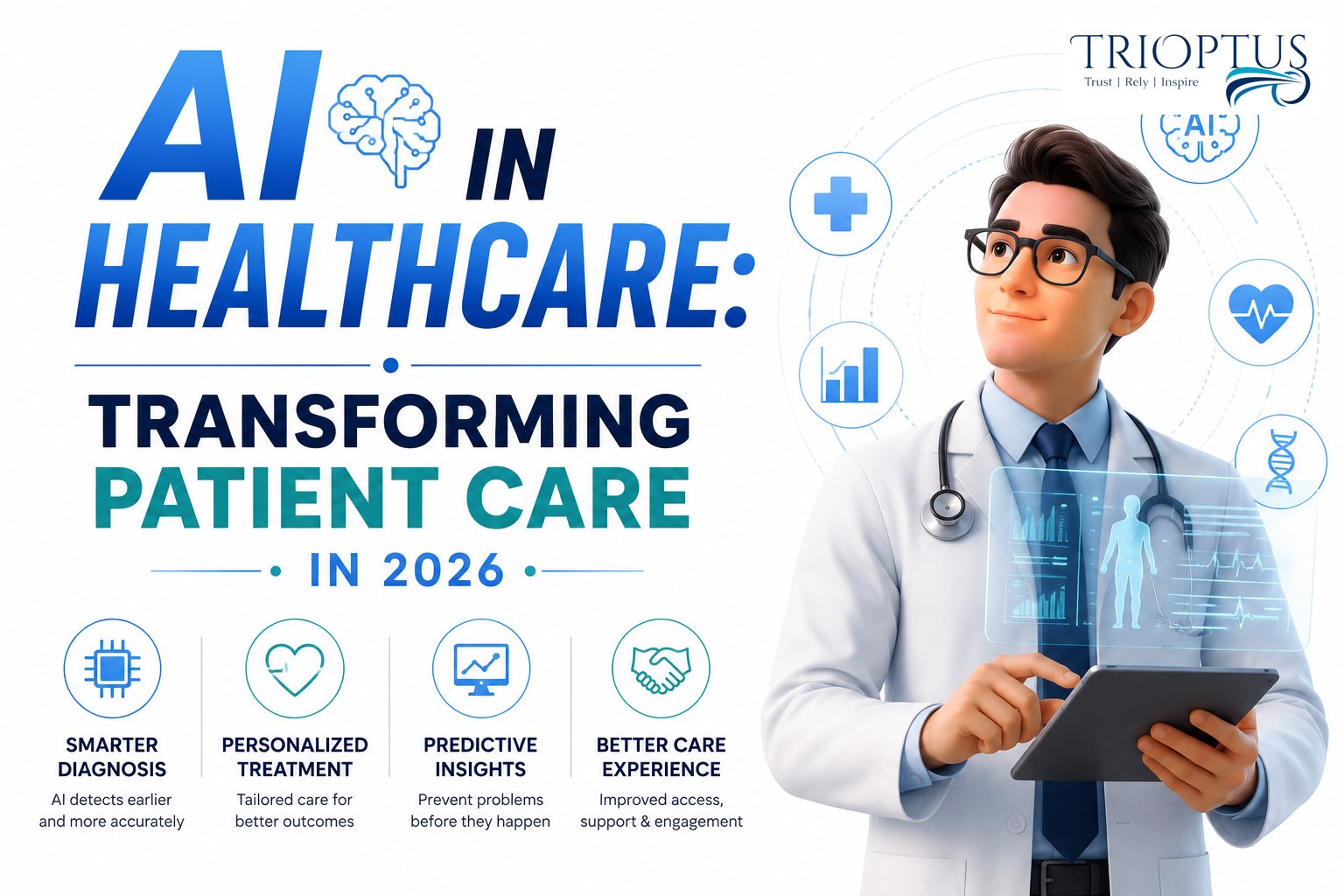
The Evolution of AI in Healthcare
Healthcare has witnessed remarkable technological advancements over the past decade, but 2026 marks a significant shift toward AI-driven care delivery. Healthcare providers are integrating AI into nearly every stage of the patient journey, from appointment scheduling and diagnosis to treatment planning, remote monitoring, and post-discharge care.
Modern AI systems can analyze millions of medical records, research papers, imaging scans, and laboratory reports within seconds. This enables physicians to make informed clinical decisions based on comprehensive, real-time information. AI has evolved from being a supportive technology into an essential partner in delivering high-quality healthcare services.
AI-Powered Diagnostics Are Improving Accuracy
One of the most impactful applications of AI in healthcare is medical diagnosis. AI algorithms can process complex medical images, pathology reports, and patient histories with remarkable speed and precision.
Advanced AI systems assist radiologists in detecting abnormalities in X-rays, CT scans, MRI scans, and mammograms, helping identify conditions such as cancer, fractures, neurological disorders, and cardiovascular diseases at earlier stages. Early detection significantly improves treatment success rates and patient survival.
By reducing diagnostic errors and providing physicians with additional clinical insights, AI enhances confidence in medical decision-making while improving overall patient safety.
Personalized Treatment Is Becoming a Reality
Every patient has unique medical conditions, genetic characteristics, and lifestyle factors. AI enables healthcare providers to develop personalized treatment plans tailored to each individual's specific needs.
Using predictive analytics and machine learning, AI can evaluate patient data, medical history, laboratory results, and genetic information to recommend the most effective treatment options. This personalized approach minimizes unnecessary treatments, improves medication effectiveness, and enhances patient outcomes.
Precision medicine continues to gain momentum in 2026, with AI serving as one of its primary driving forces.
Virtual Health Assistants Are Enhancing Patient Engagement
AI-powered virtual assistants and intelligent chatbots have become valuable tools for both patients and healthcare providers. These digital assistants help schedule appointments, answer frequently asked questions, provide medication reminders, monitor symptoms, and guide patients through basic healthcare information.
Available around the clock, virtual assistants improve accessibility while reducing the administrative workload on healthcare staff. Patients benefit from quicker responses and greater convenience, leading to higher satisfaction and better adherence to treatment plans.
As conversational AI becomes more sophisticated, virtual health assistants are playing an increasingly important role in patient engagement and healthcare communication.
Predictive Analytics Is Supporting Preventive Healthcare
Healthcare is shifting from reactive treatment to proactive prevention. AI-powered predictive analytics enables providers to identify potential health risks before serious complications arise.
By analyzing large volumes of patient data, wearable device information, lifestyle habits, and clinical records, AI can predict the likelihood of chronic conditions such as diabetes, heart disease, or respiratory illnesses. Physicians can then intervene early with preventive care strategies, reducing hospital admissions and improving long-term health outcomes.
This proactive approach benefits both patients and healthcare organizations by lowering treatment costs and promoting healthier populations.
AI Is Revolutionizing Medical Research and Drug Discovery
Developing new medications has traditionally been a lengthy and expensive process. AI is dramatically accelerating pharmaceutical research by analyzing biological data, predicting drug interactions, and identifying promising compounds in a fraction of the time required through conventional methods.
Researchers are using AI to simulate clinical trials, optimize drug formulations, and identify potential treatment options for complex diseases. This has shortened research timelines and increased the efficiency of bringing life-saving medications to market.
In 2026, AI continues to play a vital role in advancing medical innovation and supporting faster healthcare breakthroughs.
Remote Patient Monitoring Is Improving Chronic Disease Management
The widespread adoption of wearable devices and connected medical technologies has transformed patient monitoring. AI-powered remote monitoring systems continuously collect health data such as heart rate, blood pressure, blood glucose levels, oxygen saturation, and sleep patterns.
These intelligent systems analyze patient information in real time and alert healthcare providers when abnormal trends are detected. This enables early intervention before conditions become severe, reducing emergency visits and hospital readmissions.
Remote monitoring is especially valuable for elderly patients and individuals managing chronic illnesses, allowing them to receive continuous care without frequent hospital visits.
Administrative Automation Is Increasing Healthcare Efficiency
Administrative responsibilities often consume valuable time for healthcare professionals. AI is helping automate routine tasks such as appointment scheduling, billing, insurance verification, medical coding, documentation, and patient record management.
Automation reduces paperwork, minimizes administrative errors, and allows healthcare staff to dedicate more time to patient care. Hospitals and clinics are experiencing improved operational efficiency while reducing overall administrative costs.
As healthcare organizations continue to embrace digital transformation, intelligent automation has become an essential component of efficient healthcare management.
Cybersecurity and Data Privacy Remain Essential
Healthcare organizations manage vast amounts of sensitive patient information, making cybersecurity a top priority. As AI adoption increases, protecting electronic health records and ensuring patient privacy have become more important than ever.
Advanced AI-powered cybersecurity systems monitor networks for suspicious activity, detect potential threats, and respond to cyberattacks in real time. These intelligent security solutions help healthcare organizations maintain compliance with privacy regulations while safeguarding confidential medical data.
Building patient trust requires not only innovative technology but also strong data protection measures.
Challenges Facing AI in Healthcare
Despite its tremendous benefits, AI implementation is not without challenges. Healthcare organizations must address concerns related to data privacy, ethical AI usage, algorithm transparency, regulatory compliance, and system integration.
AI models rely on high-quality, unbiased data to produce accurate results. Poor data quality or biased datasets may affect clinical recommendations and healthcare outcomes. Additionally, organizations must ensure that AI supports healthcare professionals rather than replacing human judgment.
Successful AI adoption requires continuous oversight, responsible governance, and collaboration between technology experts and healthcare providers.
The Future of AI in Healthcare Beyond 2026
The future of healthcare will become even more intelligent, connected, and personalized. Emerging technologies such as generative AI, digital twins, robotic surgery, genomic medicine, and predictive population health management are expected to further transform patient care.
Hospitals of the future will increasingly rely on AI-powered clinical decision support systems, autonomous administrative workflows, and real-time health monitoring to deliver faster and more accurate care.
Organizations that invest in AI today will be better prepared to meet growing patient expectations, improve healthcare accessibility, and drive innovation across the healthcare ecosystem.
Conclusion
Artificial Intelligence is no longer a futuristic concept—it is a driving force behind the evolution of healthcare in 2026. From improving diagnostic accuracy and enabling personalized treatments to streamlining hospital operations and supporting remote patient monitoring, AI is transforming every aspect of patient care. Healthcare providers are leveraging intelligent technologies to deliver faster, safer, and more efficient services while improving overall patient outcomes.
As AI continues to evolve, its role in healthcare will become even more significant. Emerging innovations such as predictive analytics, generative AI, robotic-assisted procedures, and digital health platforms are paving the way for a more connected and patient-centric healthcare ecosystem. However, successful adoption requires balancing technological innovation with ethical practices, data security, and human expertise.
Organizations that embrace AI responsibly today will be better equipped to address future healthcare challenges, improve operational efficiency, and provide exceptional patient experiences. While AI cannot replace the compassion, judgment, and expertise of healthcare professionals, it serves as a powerful partner that enhances their capabilities and enables better clinical decision-making.
The future of healthcare lies in the seamless collaboration between advanced technology and skilled medical professionals. As we move beyond 2026, Artificial Intelligence will continue to redefine patient care, making healthcare more accessible, accurate, proactive, and personalized for people around the world.