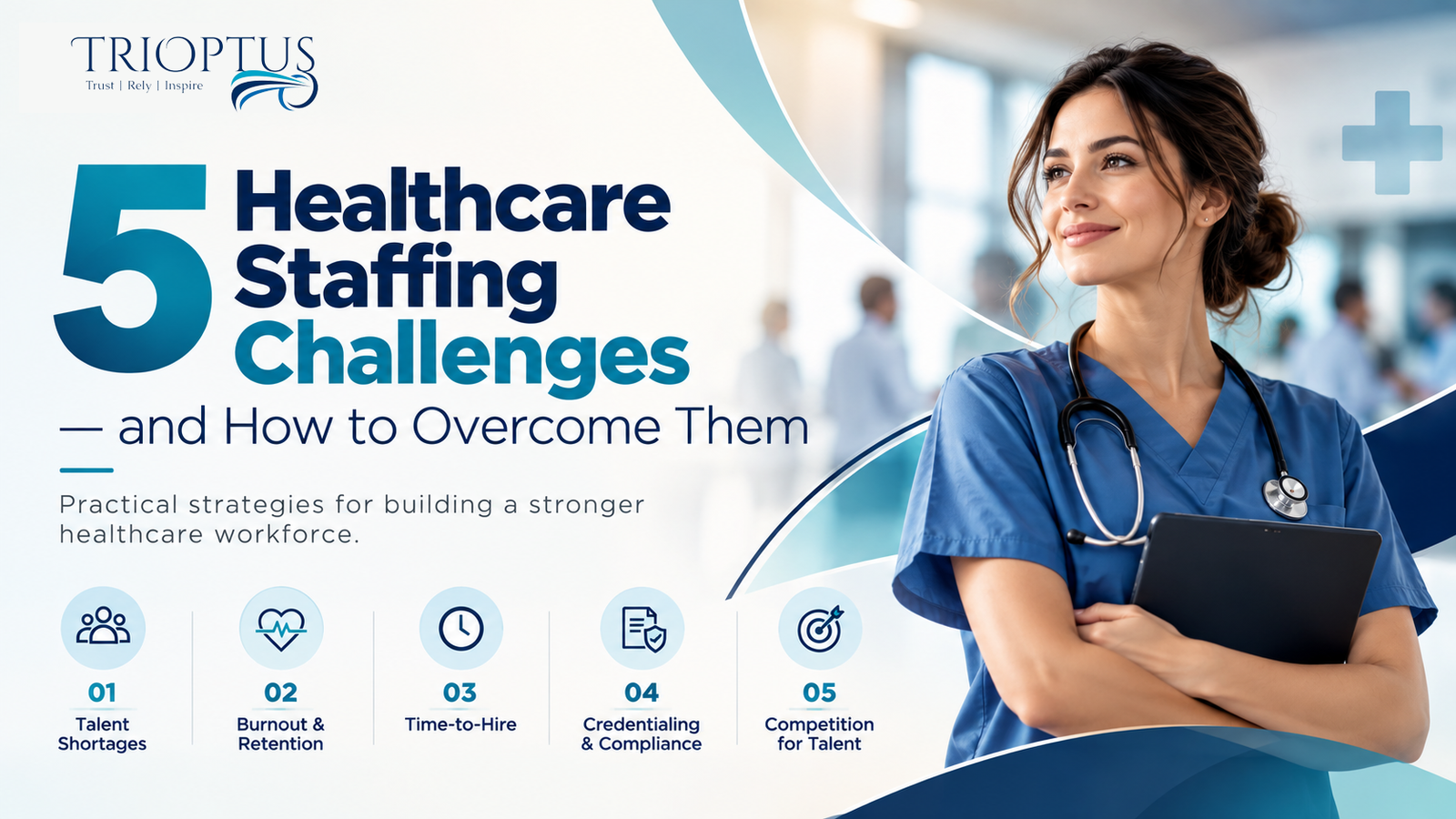
5 Healthcare Staffing Challenges—and How to Overcome Them
1. Shortage of Qualified Healthcare Professionals
One of the biggest challenges facing healthcare organizations is finding enough qualified professionals to meet demand.
Hospitals, clinics, long-term care facilities, and other healthcare providers compete for nurses, physicians, allied health professionals, technicians, and other specialized roles. At the same time, workforce demand continues to change as the U.S. population ages and healthcare needs become more complex.
For employers, this can result in:
- Longer time-to-fill for critical positions
- Smaller candidate pools
- Increased competition for experienced professionals
- Higher recruitment costs
- Greater pressure on existing staff
How to Overcome It
Organizations can expand their approach to talent acquisition instead of relying on a single recruitment channel.
A stronger strategy can include:
Build a larger talent pipeline:
Maintain relationships with qualified candidates even when there are no immediate openings.
Use multiple sourcing channels:
Combine job boards, professional networks, referrals, recruiting partners, social media, and targeted outreach.
Look beyond traditional candidate profiles:
Consider qualified professionals with transferable skills who may be able to transition into certain roles with appropriate training.
Strengthen your employer brand:
Healthcare professionals want to understand what makes an organization a good place to work. Clearly communicating workplace culture, career opportunities, benefits, and professional development can help attract candidates.
The goal is not simply to find more resumes. It is to build a consistent pipeline of qualified healthcare professionals.
2. Employee Burnout and Staff Retention
Recruiting new employees is only part of the staffing equation. Retaining existing employees is equally important.
Healthcare professionals often work in demanding environments that can involve long hours, high workloads, emotional stress, and significant responsibility. When staffing levels are low, existing employees may face additional pressure, potentially contributing to burnout and turnover.
High turnover creates another challenge: organizations must repeatedly spend time and resources recruiting and onboarding replacements.
How to Overcome It
Retention should be treated as part of the overall staffing strategy.
Healthcare organizations can consider:
Improve Workforce Planning
Use staffing data to identify where shortages are occurring and when additional coverage may be needed.
Encourage Flexible Scheduling
Where operationally possible, flexible schedules, shift options, and predictable scheduling can help employees better manage work and personal responsibilities.
Invest in Professional Development
Training, certifications, mentorship programs, and career advancement opportunities can give employees a clearer path for growth.
Recognize Employee Contributions
Recognition does not always require a major financial investment. Consistent feedback, appreciation, and opportunities to contribute can help employees feel valued.
Listen to Employees
Regular feedback can help organizations identify operational problems before they contribute to turnover.
A strong retention strategy can reduce the constant cycle of hire → train → lose → replace.
3. Long Time-to-Hire
Healthcare vacancies often require candidates with specific credentials, experience, certifications, or clinical expertise. This can make the hiring process more complicated than recruiting for many general positions.
A lengthy hiring process can cause qualified candidates to lose interest or accept offers from competing organizations.
For employers, delays can also mean:
- Increased workload for existing staff
- Longer vacancy periods
- Higher overtime expenses
- Delayed services or operational challenges
- Increased recruitment costs
How to Overcome It
The solution isn't necessarily to rush the hiring process. Instead, organizations should focus on removing unnecessary delays.
Create Clear Job Requirements
Separate essential qualifications from preferred qualifications. An overly restrictive job description can unnecessarily reduce the candidate pool.
Streamline Screening
Use structured screening criteria to quickly identify candidates who meet the required qualifications.
Improve Communication
Keep candidates informed throughout the hiring process. Even a short update can help maintain engagement.
Coordinate Interviews
Where possible, reduce unnecessary delays between screening, interviews, credential verification, and final decisions.
Maintain a Ready Talent Pool
A database of previously qualified candidates can significantly reduce sourcing time when a new position becomes available.
A faster process doesn't mean compromising quality. It means creating a hiring workflow where qualified candidates can move through each stage efficiently.
4. Credentialing, Compliance, and Verification
Healthcare recruitment comes with responsibilities that extend beyond finding a candidate who looks good on paper.
Depending on the position and work setting, organizations may need to verify licenses, certifications, education, employment history, background information, and other requirements.
These processes are essential, but they can also add complexity to the hiring timeline.
How to Overcome It
Organizations should create a consistent and organized verification process.
Establish Standardized Checklists
Create role-specific checklists that clearly identify required documentation and verification steps.
Start Verification Early
Where appropriate, begin credential and documentation checks earlier in the recruitment process rather than waiting until the final stage.
Keep Documentation Organized
A centralized process can make it easier for recruitment and HR teams to track candidate requirements.
Use Technology
Applicant tracking systems and other recruitment technologies can help organize candidate information, track hiring stages, and reduce manual administrative work.
Maintain Compliance Awareness
Healthcare organizations should ensure their recruitment and verification processes align with applicable federal, state, and local requirements, as well as relevant licensing and organizational policies.
Technology can make the process more efficient, but human oversight remains important—particularly when dealing with healthcare credentials and compliance requirements.
5. Competition for Top Healthcare Talent
Healthcare organizations aren't competing only with organizations in their immediate area. Qualified professionals may have multiple opportunities available to them, especially for roles where demand is high.
This means compensation is only one part of the recruitment equation.
Candidates may also consider:
- Work-life balance
- Schedule flexibility
- Career advancement
- Benefits
- Workplace culture
- Location and commute
- Professional development
- Leadership
- Job stability
How to Overcome It
Organizations need to clearly communicate their overall employee value proposition.
Instead of simply saying:
"We're hiring nurses."
Explain why a qualified professional should consider joining your organization.
For example:
Career Growth:
Highlight advancement opportunities, training, certifications, and mentorship.
Workplace Culture:
Show candidates what the employee experience actually looks like.
Flexibility:
Clearly communicate available scheduling options when applicable.
Benefits:
Explain relevant benefits and employee support programs.
Purpose:
Connect the role to the organization's mission and the impact employees can have on patients and communities.
Recruitment is increasingly about selling the opportunity and experience, not just the job title.
Building a More Effective Healthcare Staffing Strategy
Addressing staffing challenges individually can help, but organizations can achieve better results by taking a broader approach.
A strong healthcare staffing strategy should connect recruitment, retention, workforce planning, technology, and employee experience.
Here are several areas organizations can focus on:
1. Build Talent Pipelines Before You Need Them
Don't wait until a position becomes urgent to start looking for candidates. Build relationships with qualified professionals continuously.
2. Use Data to Guide Hiring Decisions
Track metrics such as:
- Time-to-fill
- Time-to-hire
- Cost-per-hire
- Candidate source
- Offer acceptance rate
- Turnover rate
- Retention rate
- Vacancy duration
These metrics can help hiring teams identify where the recruitment process is working and where improvements may be needed.
3. Strengthen Candidate Communication
Candidates remember how an organization treats them during the hiring process. Clear expectations, timely updates, and respectful communication can improve the overall candidate experience.
4. Combine Technology With Human Expertise
AI and recruitment technology can help with sourcing, screening, scheduling, and administrative tasks. However, healthcare staffing still requires human judgment, especially when evaluating qualifications, experience, communication, and cultural fit.
5. Treat Staffing as a Long-Term Strategy
Healthcare staffing shouldn't begin when a position becomes vacant. Organizations that continuously build talent pipelines, monitor workforce trends, and invest in retention are better positioned to respond when staffing needs change.
The Role of Healthcare Staffing Partners
For organizations facing persistent staffing challenges, working with an experienced healthcare staffing partner can provide additional support.
A staffing partner can help organizations with areas such as:
- Candidate sourcing
- Talent pipeline development
- Recruitment support
- Candidate screening
- Workforce planning
- Specialized staffing
- Recruitment process optimization
The right partnership can allow internal HR and hiring teams to focus on strategic workforce priorities while gaining additional support with the recruitment process.
However, successful staffing partnerships depend on more than filling positions. Organizations should look for partners that understand their workforce requirements, communicate clearly, maintain appropriate quality standards, and understand the specific needs of the healthcare environment.
Conclusion
Healthcare staffing challenges are not likely to disappear overnight. Competition for qualified professionals, employee retention, lengthy hiring processes, compliance requirements, and changing workforce expectations will continue to shape the healthcare employment landscape.
But organizations don't have to address these challenges reactively.
By building stronger talent pipelines, improving the candidate experience, investing in retention, streamlining recruitment processes, and using workforce data effectively, healthcare organizations can create a more sustainable approach to staffing.
The goal isn't simply to fill an open position. It's to find the right people, support them once they join, and build a workforce that can grow with the organization.
For healthcare organizations, a proactive staffing strategy can turn recruitment from a recurring challenge into a long-term workforce advantage.